
Students Meet With Dean of Students and Provost to Discuss Future of AI on Campus
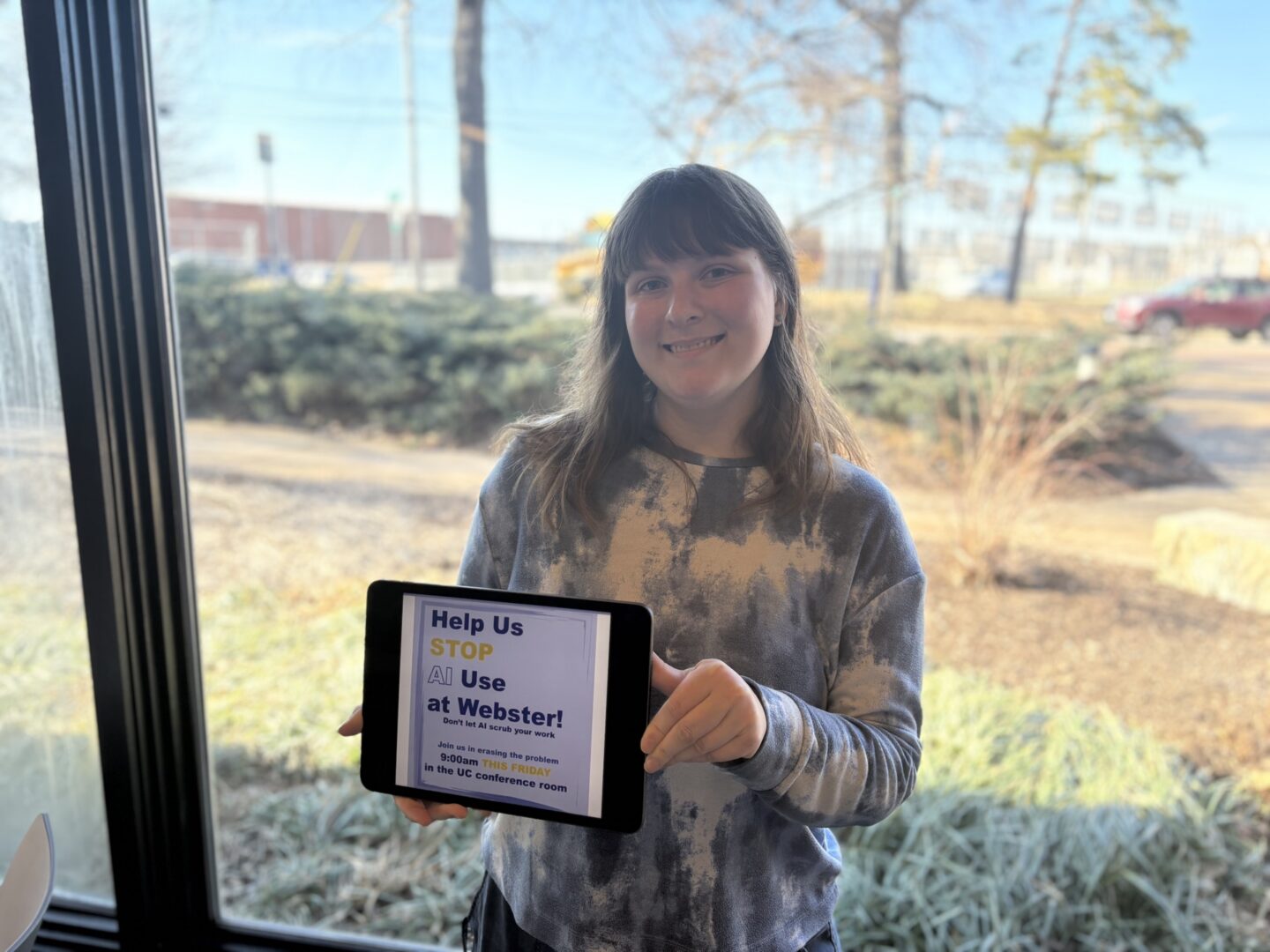
Karlene Hoch is just one of the many students who feel attacked by the acceptance and use of generative artificial intelligence (AI) on campus. In the hopes to see change at the university, students emailed their concerns about generative AI to administrators last semester. In turn, Student Affairs hosted an in-person conference at the University Center Conference Room on Feb. 6.
Three students attended the conference along with Dean of Students John Buck and Interim Provost David Schmidt. In addition to the in-person meeting, a virtual link was set up for anyone who wanted to attend remotely. Two students were present online.
After receiving student emails regarding AI on campus, Schmidt discussed with university officials and discovered that Webster does not have an official AI policy, unlike surrounding schools within the St. Louis area. He plans on looking at different policies to help establish one for Webster. Schmidt also met with the AI faculty committee, composed of faculty nominated by deans from each school, to express the lack of policy.
Buck and Schmidt emphasized the importance of having a student voice in regard to conversations about AI on campus.
“When I met with the committee I did say I would nominate or ask a student, or students, to serve on that committee if we expanded,” Schmidt said. “Typically what we would do is we would have a representative from each of the schools or colleges, or make it even larger and make it even larger, and make it from each major.”
Schmit asked student attendees for their feedback on how to implement an AI policy that will serve the institution.
“If we bite off more than we can chew, we know that it takes a tremendous amount of power to power AI, but I don’t know if that is going to serve us well in implementing a policy on how we can use it first in the classroom,” said Schmidt. “We can’t just ban AI. We can ban the implementation of AI in certain aspects.”
Illustration majors Hoch and Mikaila Zanghi, along with Graphic Design major Olly Persoon, offered their perspective on banning generative AI on campus.
“Treat it the same way you treat plagiarism,” Hoch said. “If you find someone submitting a paper that isn’t their own, first give them a formal warning, and then second, if they do it again, expel them.”
Both Buck and Schmidt expressed their concerns with banning AI and interfering with academic freedom. In regard to academic freedom, Schmidt said some faculty members, including professors, have the freedom to establish their own AI policy in the syllabus.
“I think most of our faculty will say, with respect to AI for writing papers, writing research — ‘we will set boundaries and we will set rules,’” Schmidt said.
University faculty is divided on whether the technology can be used as a tool in the classroom or not. Students in attendance brought up how the Business and Technology school is promoting AI more than other schools.
“AI has been known to hallucinate and give faulty information,” Hoch said. “So, I don’t understand why you’d be having us use a broken tool. Why should you be allowing me to [use AI]?”
To gain an insight on the university’s plan to combat the environmental effects of using generative AI, Hoch asked Schmidt on ways that the institution will counteract the environmental aspects.
“I don’t know that any university is positioned to take on that directly as a cost offset,” Schmidt said. “It doesn’t mean that the issue is any less validating than anything else. It might be beyond the scope of what one institution can do.”
In response Hoch said, “I’d say AI is beyond the scope of what the university should allow.”
Buck said that there are programs which students are utilizing that allow them to record lectures and the AI will generate a study guide based on what it hears. These generative AI programs can enhance performance in academics, but there are concerns regarding what students are actually comprehending from these generated study guides.
“[The student] can just walk off and have this thing record [and generate] the study guide. There’s no thought from human to person who needs to absorb that knowledge to learn. It just does it. You don’t take anything away [from it],” Zanghi said.
Because AI can be inaccurate, Buck said that students are taking a risk in trusting these programs and it is on those students if the study guide is incorrect.
“It’s on the people who are directly environmentally impacted by what AI is doing,” Hoch said.
To continue tackling the issues surrounding AI, Schmidt is proposing a subcommittee to work with the faculty committee.
“Typically what we would do is we would have a representative from each of the schools and colleges, or we could make it even larger and make it from each discipline,” Schmidt said. “I could ask the deans to nominate students or the faculty to nominate students from each of these. There have to be student voices in this.”
After the meeting adjourned, The Journal met up with the three students. Each student felt their voice was not heard in the way they wanted it to.
Students said that AI’s presence makes them and others feel unsafe, such as how the technology sometimes gives racist results when told to depict those of varying races and cultures.
”AI perpetuates a lot of racial stereotypes. It doesn’t fit with the general idea of Webster. We have so many international students,” Persoon said.
Hoch said that Webster is losing what made her choose the school in the first place.
“We should be united. Diversity, equality and inclusion is a big part of what this college stands for. This is why I showed up here,” Hoch said. “Knowing that a harmful system is being encouraged by this university really walks all over me. I need to get my degree [and] it is too late for me to go anywhere else.”
Certain aspects of the technology might be prohibited on campus in the future, but any specific decisions have yet to be made.
Persoon said that even though AI is prominent in the business world, there is a lack of AI policies in the United States. He wants to create change by helping Webster come up with its own way to combat the issues with AI.
If Webster implements a generative AI ban or policy, all three students said they would feel safer.
“Why can’t we be the leading step? [Schmidt] was referring to what other universities did,” Persoon said. “We can make our own decisions. We don’t need another bigger university going, Webster, this is what you can do.”
