
AI Panel Weighs Ethical, Creative and Environmental Concerns
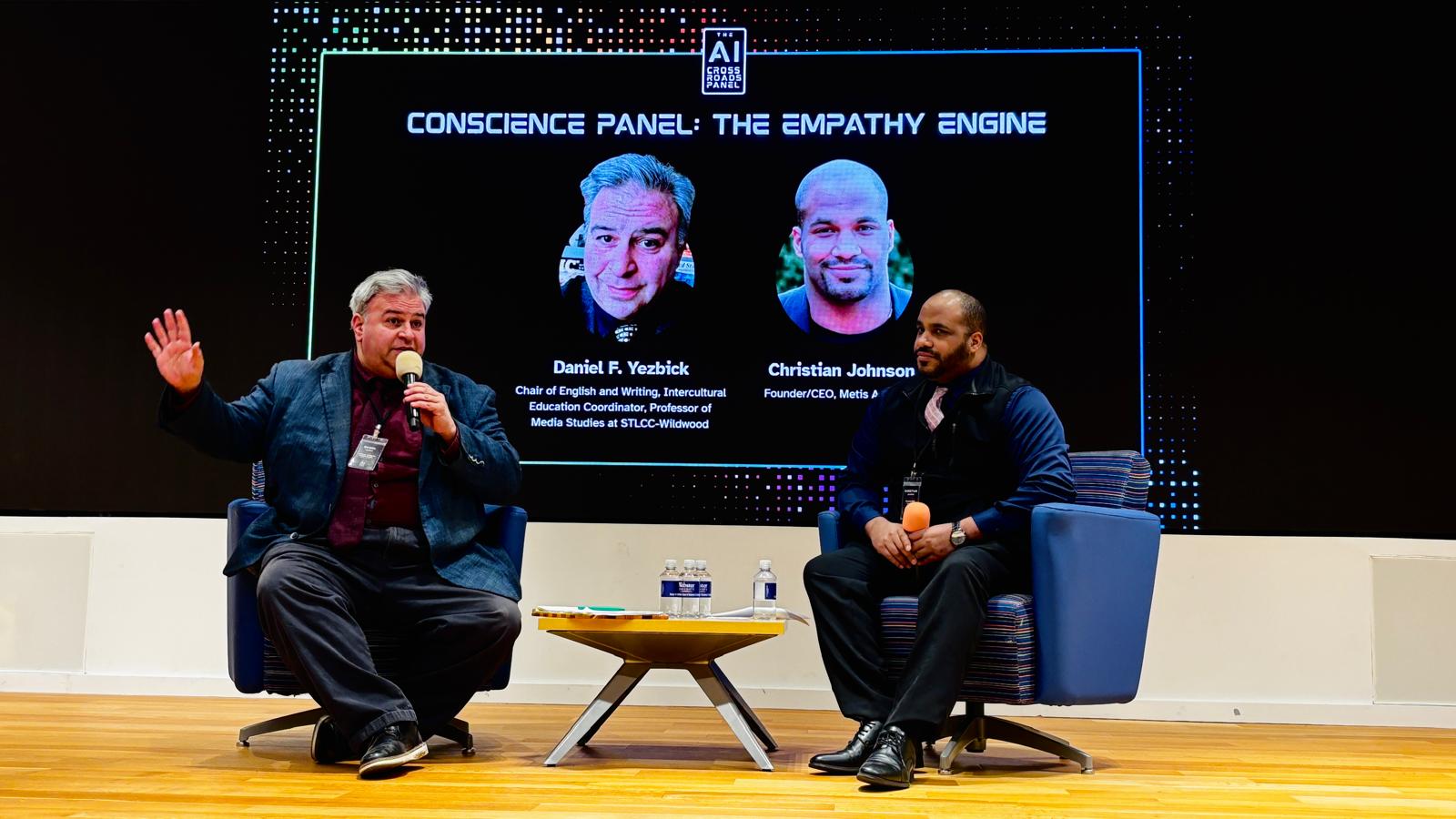
Artificial intelligence took center stage at Webster University when the Computer Science Club hosted “The AI Crossroads Panel,” a three-part discussion about how AI may affect creativity, mental health and environmental sustainability.
For computer science major and organizer of the panel Muazuddin Mohammed, The AI Crossroads Panel was a months-long passion project.
“Since we have this amazing benefit of having such diverse perspectives on campus, I wanted to create an event that bridges those different perspectives. So, a place where we can come and have conversations, discussions and educate each other about the positives and negatives of this technology,” Mohammed said.
Mohammed attended the Global Student Leadership Summit (GSLS), an annual conference designed to unite potential leaders from around the globe to make a change by confronting worldwide problems. The GSLS helped Mohammed better understand AI.
“One of the global issues that we were working on and discussing was the impact of AI. Prior to that point, I feel like I was obliviously using AI,” Mohammed said. “I wasn’t really aware of how data centers are not being sustainably run and negatively impacting our future from the environmental aspects of it. I was briefly aware of the cognitive offloading that’s happening.”
After learning more about the complications of AI, Mohammed started having more conversations about the technology and wanted to share that knowledge with the student body.
To address AI’s effects on creativity, mental health and sustainability, Mohammed reached out to various faculty and industry leaders to participate as panelists.
Panelists included Basiyr Rodney, chair of Webster’s Department of Teacher Education; Tara Plachowski, a visiting assistant professor of Webster’s Department of Teacher Education; Nicholas Johnson, chair of Principia College’s sustainability department, Daniel Yezbick, chair of English and writing at St. Louis Community College Forest Park; Christian Johnson, founder and CEO of Metis Analytics; and industry leader Scott Rappold.
Trying to find speakers proved challenging, Mohammed said, as the technology is still new to many. He wanted guest speakers who were experienced and could expound on the current state of the job market considering the influx of AI in the workforce.
Audience member Kelsey Kozuszek, an international relations and business major, said each section of the panel was represented well.
“No one was strongly 100 percent pro-AI and no one was 100 percent anti-AI. I think they did a really good job incorporating academic and student perspectives,” Kozuszek said.
Before attending, Kozuszek said she was “cautiously optimistic” about AI.
“I was seeing the benefits in academia and making certain concepts and things more accessible, like resume reviews, as well as academic assistance, but I was still able to understand that [AI] isn’t perfect,” Kozuszek said.
She said the creative panel especially stood out to her.
“If you want to create a super specific image, you don’t need AI every time. It’s something that instead of putting hundreds of prompts into AI, you could photoshop it faster,” Kozuszek said. “It was really nice to understand the creative perspective and incorporating how people can use [AI] if they so choose, but also understand that there are alternatives.”
Kozuszek said the panel also raised concerns about creating an “ethical AI model.”
“One of the panelists said that it is important to have that friction between AI models and kind of having a variety of different perspectives that are represented,” Kozuszek said. “That’s something I am still thinking about and grappling with mentally. And if you’re missing part of that demographic, if you’re missing a portion of people that are represented, then they won’t get the answers that are actually reflective of everybody.”
Kozuszek said the event raised more questions than answers. In order to have these conversations, Kozuszek said that people need to have an open mind.
“I think it’s ultimately the goal — don’t have these conversations to change someone else’s opinion, [but to] see it from their perspective. My opinion on AI didn’t necessarily change. I think it honestly made it more nuanced and complicated, which I appreciate, because no issues, especially of this scale, is black and white,” Kozuszek said.
Having unbiased conversations about AI is important to Kozuszek. She said that seeing other people’s perspectives and opinions is what is needed to solve problems with the technology.
Kozuszek hopes that there are more events like this in the future.
Mohammed said he wanted to shine a light on the pros and cons of AI and spark conversations to get people thinking.
“I think attending events like these, or being in spaces where you can have respectful conversations with each other and learn from each other, is a great way to be on a college campus. Educate yourself and inform yourself, [while] being aware of the good side [and] also the negative side,” Mohammed said.
