
Majoring in Uncertainty

Vanessa Miller sat in her car holding a list of pros and cons.
The decision she faced — whether to follow passion or practicality — would shape the rest of her college career, and, if all goes to plan, her life.
Students nationwide have long faced the challenge of choosing a college major. However, in an era of ever-changing economies, emerging technologies and political uncertainty, those choices are made with more caution.
According to a survey by Student Choice, the most popular majors in 2024 were business, nursing, psychology, education and computer science, all considered relatively stable career paths.
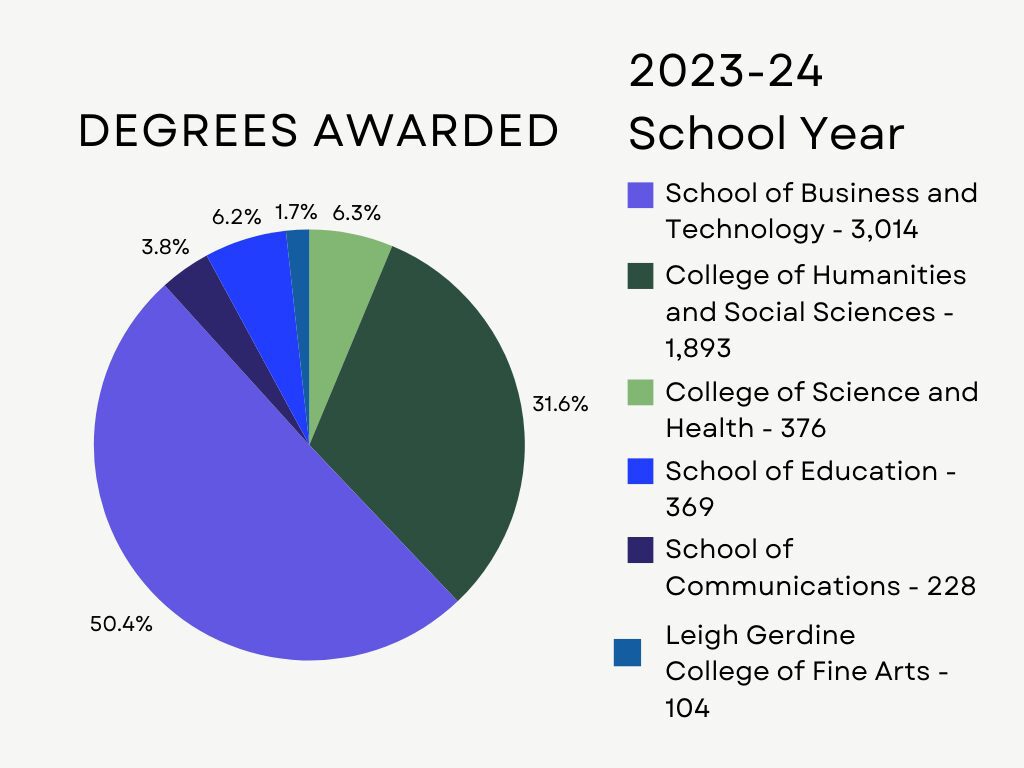
Using data collected in May 2024 from all of Webster’s campuses, the School of Business and Technology graduated thousands of students, with the IT management program awarding more than 1,000 graduate degrees alone. However, programs from the School of Communications and the Leigh Gerdine College of Fine Arts graduated dozens, rather than hundreds.
For some students, stability drives choice. Senior psychology major Bella Lyskowski said personal interest led her to the major, but job opportunities reinforced it.
“I feel like psychology is a pretty safe major,” she said. “There are a lot of jobs within the field that you can do with a bachelor’s in psychology and the degree can apply to many jobs outside the field.”
Artificial intelligence is also on students’ minds.
“AI has been such a big topic of conversation in my classes, both in how it’ll affect
people and also if AI will be able to replace therapists,” Lyskowski said. “In my mind, AI does such a bad job with any kind of therapy that it will never be able to truly replace therapists. I do worry that it will, which would be bad for me and my career.”
For Miller, a junior, the path hasn’t been simple. She began as a music education major, believing it offered stability.
“I decided to go with my safe bet of music education because clearly, schools need more teachers, right? Wrong,” Miller said. “The past two years … I’ve been hearing about multiple music programs closing down because school funding has gone down. All the arts classes are being shut down rapidly.”
Miller chose to remain in music, but shifted to a major in the subject with a minor in psychology. She describes the decision as both personal and practical.
“I chose music because I want to help people,” Miller said. “This was actually my family’s version of a practical option. They were worried about the economy of teaching because they were able to see more ahead than I was.”
For other students, passion remains the driving force. Junior Olivia Prothro chose animation simply because she loves it.
“It was the energy and influences of the animation-related spaces that made me choose it,” she said. “The behind-the-scenes of shows I liked such as ‘The Amazing World of Gumball’ and ‘Chowder’ showed so much fun and creative drive that I gravitated toward it.”
But animation, Prothro acknowledged, comes with risks.
“You’re putting yourself out there and the future of the market isn’t defined,” she said. “Many people in this industry go years or even decades until they can sustain themselves, while doing what they love and that’s just reality that has to be accepted with the major.”
The balancing act between passion and practicality is common, said Kerry Lee, interim director of Webster’s Career Planning and Development Center.
“When there’s more financial issues, when the labor market gets a little more challenging, a lot of people do think about job security more,” Lee said, noting parallels with students who came of age during the 2008 financial crisis.
Lee said practical majors continue to grow at Webster and nationwide, while creative majors remain smaller.
“We always have students that are going to pursue [creative programs] because that is truly their passion,” Lee said. “I would not pick something just because it felt safe. But at the same time, the more informed you are, the better decisions you make.”
For students feeling torn, Lee encourages “parallel planning,” pursuing a passion, while also building skills and networks that lead to stable career opportunities. That might mean a double major, minor or simply taking classes beyond one’s major.
“Sometimes, students are really committed and they say, ‘I want to be an English major … but I’m getting a lot of pressure from other people. I don’t know how to talk about it with my family who say that I’m not going to have a job and I’m going to work at McDonald’s,’” Lee said. “Regardless of what you’re majoring in, there’s always going to be that pressure.”
Prothro is considering ways to balance her major with a more stable minor.
“I’ve thought of minoring in business or graphic design,” she said. “It’s a plan I’ve had since last semester to do at least something that’ll balance out my major.”
Prothro adds she chose to major in animation with the knowledge that AI would become more advanced.
“I’m still concerned about it and how it will affect artists that use it in their own development,” she said. “I feel like to know any art, you have to do it yourself first. I’m worried that it’s what people will ask or expect of me and that it will stunt my growth.”
Lee said the uncertainty won’t go away, especially with questions surrounding AI, shifting labor markets and rising tuition, but students can prepare themselves.
“None of us have a crystal ball,” Lee said. “What students can do is future-proofing, having a diverse skill set. People tend to be more satisfied with their career choices long term when they feel like they get to use their strengths, they are interested in the work and they’re engaged in it.”
