
An Autopsy of Emerald Fennell’s Wuthering Heights
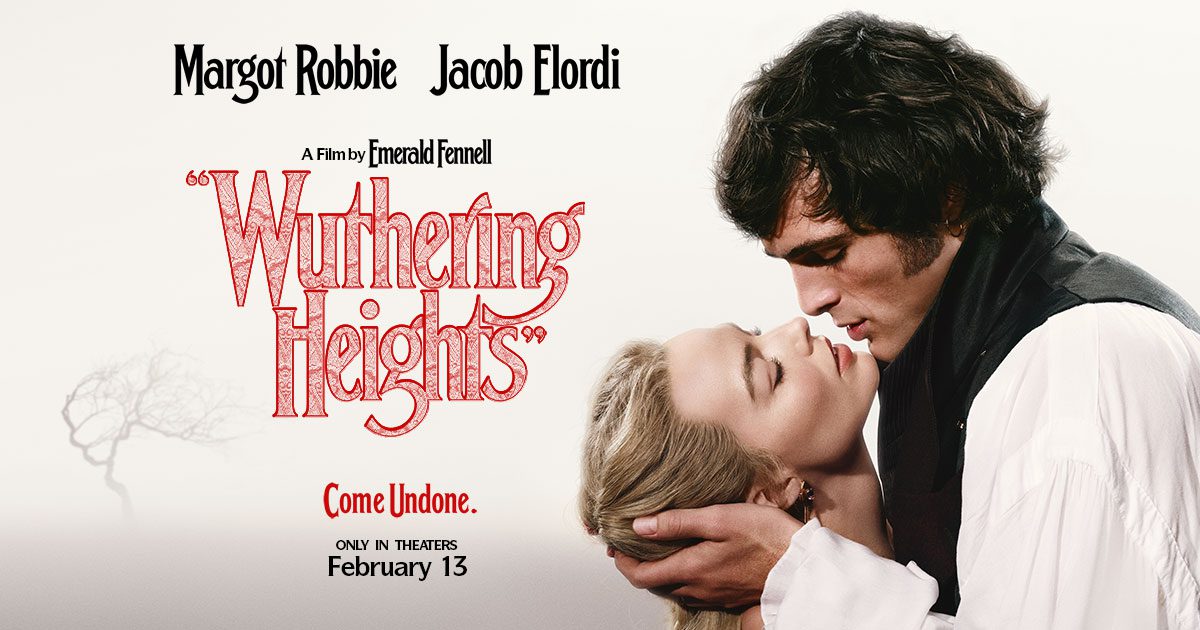
Director Emerald Fennell’s “Wuthering Heights,” an adaption of Emily Brontë’s novel of the same name, has been drawing audiences into theaters. The intrigue comes from the forced off-screen relationship between its stars, Margot Robbie and Jacob Elordi, the stunning and strange trailers showing off Fennell’s signature, Pinterest-worthy visuals and the strange moments she puts in her films that leave audiences talking.
However, the film also quickly became controversial with the many changes made from its source material, such as aging characters up, removing certain characters and, most notably, race swapping one of most prominent characters, Heathcliff. In the novel, the character is described as a Romani man, while the adaption casted Jacob Elordi, a white man.
Directors straying away from the source material to create something radically different is nothing new. Guillermo del Toro’s recent “Frankenstein” adaptation is an example of this. But the difference with that change is that Toro’s “Frankenstein” enhances the story and pulls out elements and themes that were there for interpretation. However, in Fennell’s adaptation, all of the haunting melodrama is taken away and instead replaced by a steamy sexual affair that lacks all the depth that Heathcliff and Cathy’s relationship in the book has.
I was first introduced to “Wuthering Heights” via Kate Bush’s song inspired by Emily Brontë’s novel. Bush’s captivating vocals and whimsical melody inspired me to read the book. When I did, I was lured into a story that touched on themes such as race, class, the cycles of abuse and more – all told through a haunting and destructive romance.
Somehow, an 18-year-old Kate Bush managed to truly encapsulate Wuthering Heights in a four-minute song better than Fennell did with a two-hour-and-16-minute film.
In Brontë’s novel, all of the story’s vital themes are encapsulated within Cathy and Heathcliff’s relationship. By delving into the deep sense of unexplored yearning the two have for one another, the characters exhibit self-destructive behavior and their relationship causes them to not only ruin themselves, but also those around them. Cathy herself says that she and Heathcliff are one and the same. Even in the end, when Cathy is dead, her spirit continues to haunt Heathcliff.
There’s a lack of tension in the film between the two. Instead of a deeply tragic and complex relationship, viewers are instead left with a generic dark romance that’s focused on shocking sensual moments that have no real substance.
The visuals, however, are breathtaking, such as the red sky behind Heathcliff as he rides away on a horse or the moody, foggy hills of moors. I was in awe of the sets and the lighting, which made the experience of watching this worthwhile — even if the story falls flat.
When adapting “Wuthering Heights,” Fennell said she wanted to make an adaption based on her memories when she first read the book at 14, going as far to put the title “Wuthering Heights” in quotations on the movie poster. Due to this, there are many changes made in this movie that differ from its source material.
Fennell’s decision to white wash Heathcliff does nothing for his character. In the book, Heathcliff is ostracized for his skin color and grows resentful over time, later turning him into a villain. Instead of a gripping narrative about how racism and abuse can turn a victim into a villain, we get a story arc of Elordi’s Heathcliff getting pissy because he’s too poor to marry Cathy and that’s what turns him into a “villain.”
But Fennell’s Heathcliff is hardly a villain. Instead he’s a sad, tortured, bad-boy-heartthrob archetype that has been done plenty of times already. It’s hardly interesting or gripping. It seems as if Fennell is too scared to turn her muse, Elordi, into the actual monster that Heathcliff was in the book. Heathcliff is no longer a man that hangs a dog or abuses a small child. Rather, he’s just a 6-foot-5-inches simp for Robbie’s Cathy, completely stripping the character of Heathcliff of all his complexities.
Robbie’s Cathy isn’t much better. Having aged Cathy up in this adaptation, a woman near spinsterhood instead of an older teen girl, makes Cathy’s behavior come off as childish and grating.
With both Robbie and Elordi’s chemistry falling flat, it makes it hard to get invested in the affair these two characters are having and makes it impossible to root for them as a couple. Both actors fail to completely encapsulate the characters they’re supposed to be playing.
It doesn’t feel like watching Cathy and Heathcliff; it feels like watching Elordi and Robbie give a performance for a school play of “Wuthering Heights.”
Not all performances in this film are a miss. Hong Chau’s portrayal as Nelly Dean, the servant and the primary, unreliable narrator in the novel, is captivating as Nelly is portrayed as a villain who’s getting in the way of Cathy and Heathcliff’s love. Chau’s line delivery sells the villainess of Nelly Dean, as each line she speaks oozes with a sense of authority.
Alison Oliver’s performance as Isabella Linton is both polarizing and endearing, with the actress herself doing a fantastic job captivating every moment she’s on screen. Unfortunately, the character of Isabella has been drastically watered down from the source material. From being a naive young woman who is in love with Heathcliff, and then later becoming a victim of his abuse, she instead is turned into someone who gets off on Heathcliff’s degradation and barks like a dog for pleasure. In her adaptation, Fennell made the decision to take the abuse Isabella endures at the hand of Heathcliff and sexualize it.
The costumes in this film can be hit or miss, lacking any sort of historical accuracy when it comes to representing the late 17th-century time period the film is supposed to be taking place in.
Despite this, there are still some stand out moments, such as Cathy’s red latex dress and Isabella’s wardrobe expertly suiting her character, showing off her girlish charm and naivete through costume. But when the costumes miss, they miss hard, like a pink dress worn by Robbie’s Cathy, looking like a leftover costume from “Barbie.”
Fennell’s adaptation leaves much to be desired as the film ends halfway through the novel, leaving the story woefully incomplete. Now, Cathy dies in the end, along with her unborn child, meaning there’s no second generation that overcomes and rectifies the generational trauma as they do in the book.
The most egregious thing, however, is that there is no ghost of Cathy that haunts Heathcliff, removing one of the most well-known things about the novel, leaving the gothic horror of the story left untouched.
Overall, Fennell seems to be more focused on shock value and pretty visuals rather than encapsulating the spirit of one of the most famous gothic novels. If Fennell wanted to make a provocative period piece, perhaps it would’ve just been better if she wrote her own screenplay instead of undertaking one — a story where she does nothing to expand on its themes or characters.
