
Advisory Board Advocates for Campus Diners
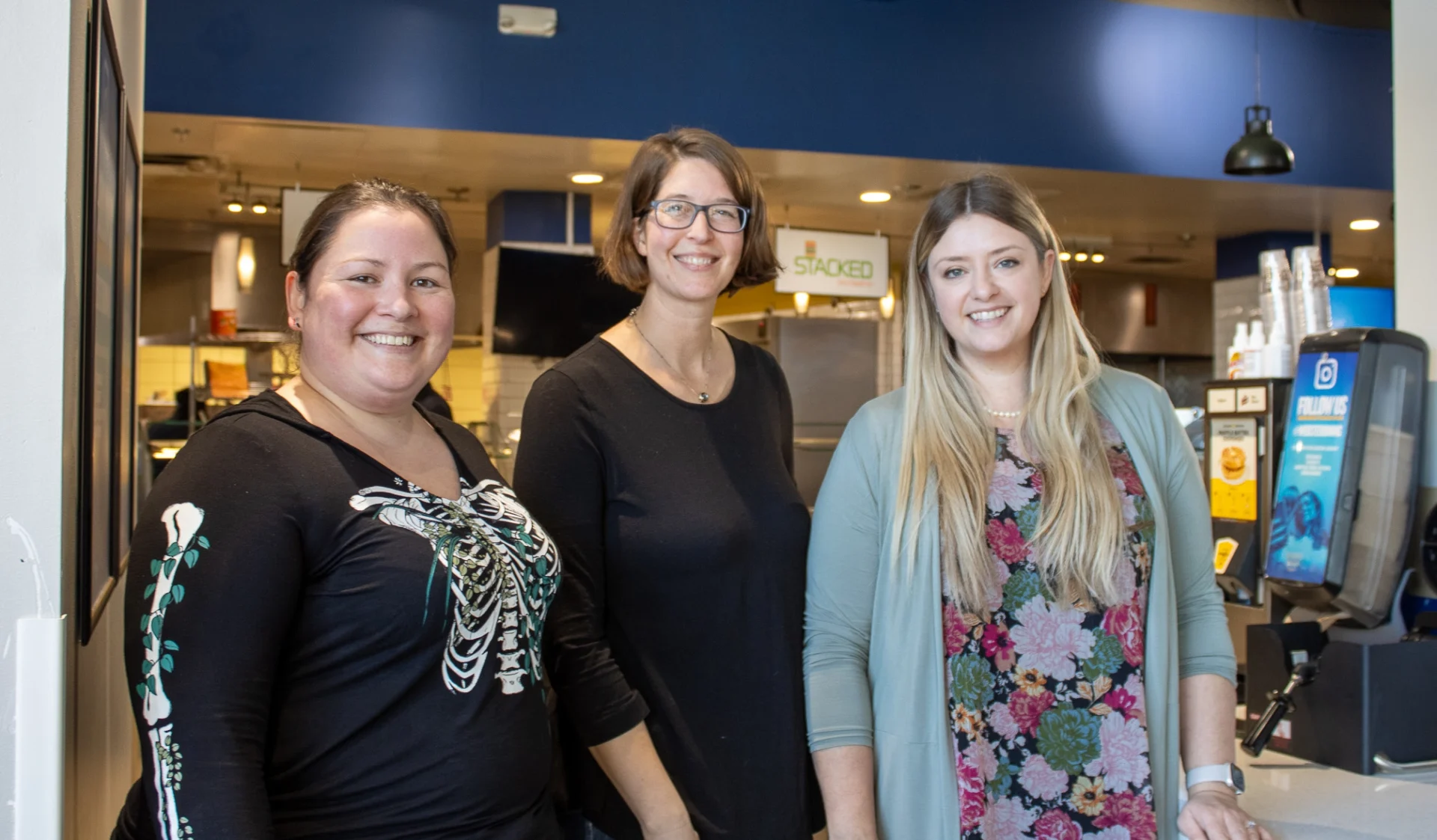
The Dining Advisory Board’s three co-advisers (L to R): Danielle Jones, general manager of dining services; Katherine Knetzer, director of the University Center; and Rachael Amick, director of Housing and Residential Life.
“But also to speak with those friends that are in their circle and other people that they’re noticing in the dining area at the same time,” Knetzer said. “Or if they’re a student athlete, ‘Hey, talk to the other people on your team. What do they think about campus dining?’ If they’re a resident, talk to the residents on their floor.”
Tunga said her friends are honest with her about what they like and dislike.
“I’m not really representing [Webster], so I guess it’s definitely an easier way for them to be like, ‘Oh, if this sucks, it sucks,’” Tunga said. “I have two people that have told me they really don’t enjoy breakfast and I went to try it, and now, I’m bringing that up next meeting. I don’t think anyone’s ever felt the need to tell me, ‘Oh, yeah, the food’s great,’ and lie about it, because really, what do you gain from that?”
Both Brun and Tunga said dining services encourages honest feedback.
“They say, ‘We really want negative feedback, because negative feedback is how you improve.’ In the survey you complete, one question is ‘What did you like?’ and the second one is ‘What did you dislike? What would you like to improve?’ So they do force you to answer what was not good,” Brun said.
Webster Dining plans to release campus-wide surveys.
For $700 each a semester, six Webster University students are paid to act as food critics for Webster Dining. Their feedback this school year has already led to change, such as a new halal station and the addition of a baker.
The students make up Webster’s Dining Advisory Board, a group designed to serve as a direct connection between students and dining.
Each week, members are required to eat at one assigned spot on campus – such as Marletto’s Marketplace or Cyber Café – and one other dining location of their choosing. Afterward, they submit an evaluation to the board’s three co-advisers: University Center director Katherine Knetzer, dining services general manager Danielle Jones, and Housing and Residential Life director Rachael Amick.
“The evaluation asks everything under the sun about their dining experience,” Knetzer said. “Was it clean? Were the tables wiped off? Were the trash cans emptied at an appropriate time? … It also asks about, of course, the quality of the food. If it was hot, was it hot? If it was cold, was it cold? Did it taste good? Did it have good eye appeal?”
If a concern needs immediate attention, Jones sees the report immediately, allowing dining services to address issues in real time.
The board’s feedback has been the reason for recent campus dining changes.
One addition is Marletto’s halal station, Saffron and Spice. Under previous dining provider Sodexo, halal meat was offered, but was prepared alongside other foods, creating a risk of cross-contamination. The new station is fully separated.
Board member Octave Brun, an international student from France, said members repeatedly raised concerns about the quality of pastries, which led to the hiring of a full-time baker over winter break.
“We did say a few times the pastries at Marletto’s weren’t too good,” Brun said. “Students said they tasted fake, not homemade. And based on this feedback, they decided to recruit a baker. Now they have a pastry chef at Marletto’s … and that was directly – Danielle told us – ‘a consequence of your feedback.’”
According to Jones, the new baker makes items from scratch.
“She has a really great background working in country clubs, doing really fancy plated desserts, so she brought a lot of knowledge to our kitchen today,” Jones said.
Knetzer said Jones and her American Dining Creations (ADC) team have embraced Webster’s feedback.
“ADC has come in with a really strong desire to use the feedback that they’re getting very quickly and quickly address any issues,” Knetzer said.
Despite its impact, board members Brun and Chesper Tunga said most students don’t know the board exists. Tunga, an international student from Rwanda, said she did not know about the group until she saw a flyer and initially assumed it was new, though it began in 2008.
“It could be more advertised,” Brun said. “I don’t think everybody knows. I don’t think they know who we are … that would be an area of improvement, for sure.”
Board members are selected by the advisers through an application process that considers the quality of responses and campus demographics.
“The students are meant to be as representative of the student body as much as possible,” Knetzer said. “Hopefully, they’re coming from a lot of different mindsets about food, a lot of different experiences around food. And that way, they can really feed into our overall understanding of how students are experiencing dining on campus.”
This year’s board includes six undergraduate students: two freshmen, one sophomore, two juniors and one senior. Four students are from the George Herbert Walker School of Business and Technology, the other two are from the Leigh Gerdine College of Fine Arts and the College of Science and Health. Half are international students and one is a commuter.
Members receive $350 in dining dollars and a $350 scholarship each semester.
The group meets twice a month to discuss the current state of dining and student concerns. Members are expected to gather feedback from other students, as well as report on their own experiences.
“We want those students to not only represent their own experience in campus dining, but also to speak with those friends that are in their circle and other people that they’re noticing in the dining area at the same time,” Knetzer said.
Webster Dining plans to release campus-wide surveys each semester and encourages students to share feedback at any time. Students can email housing@webster.edu with concerns or suggestions.
“Students have the ability to change the future regarding dining,” Brun said. “As long as you provide feedback … they’ll make changes. They will adapt. They’re here to serve us.”
