
Students Adapt to Sticker Shock at Checkout
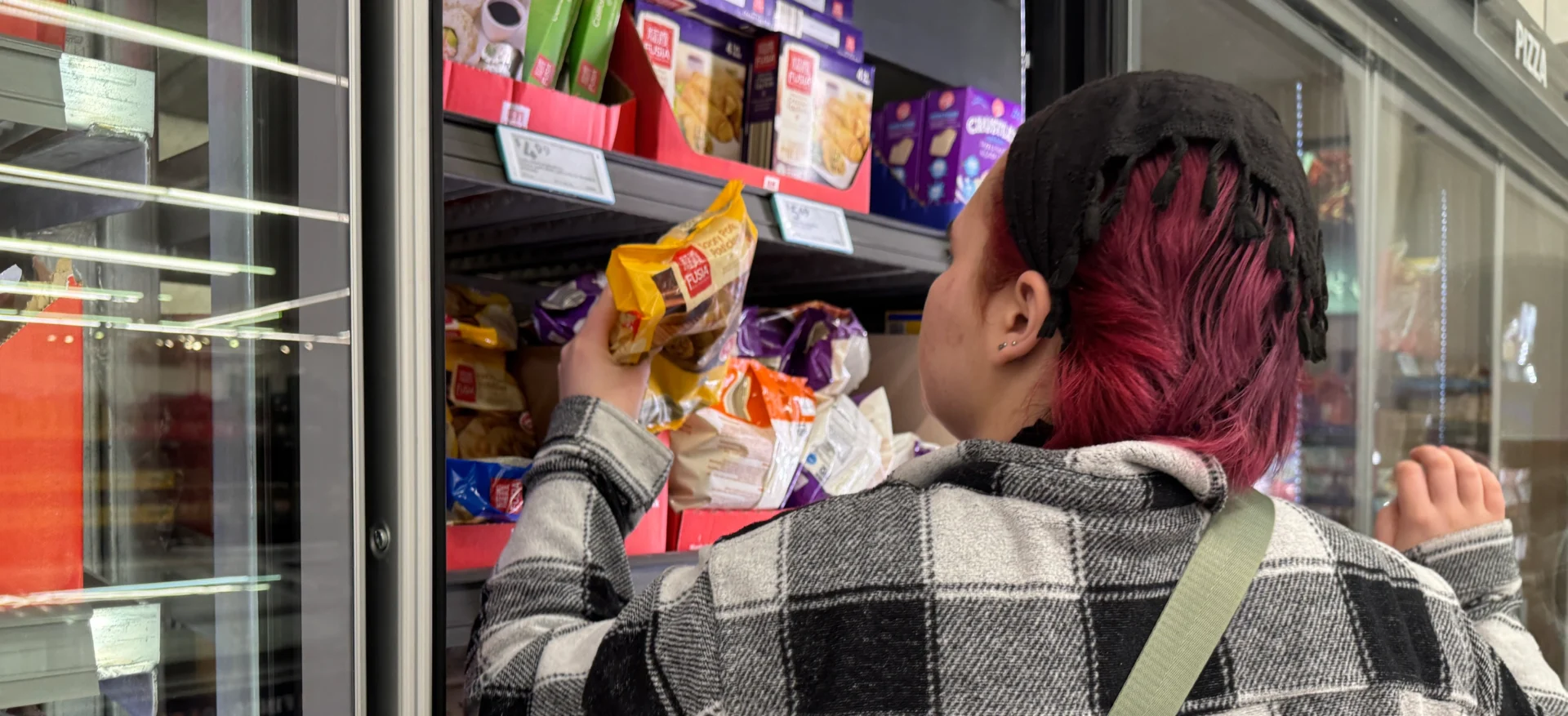
Senior Cecilia Tornetto could not afford to eat with- out SNAP.
SNAP, the government food program that sup- ports low- to no-income individuals, uses an Elec- tronic Benefits Transfer (EBT) system to transfer funds to a reusable debit card for qualified recipients like Tornetto.
“Simply put, even with EBT, I think that it’s hard for me to manage my money and to buy groceries that work for me and my schedule.”
Tornetto is one of many students on campus who rely on outside support to combat the effects of rising grocery costs.

The USDA reports food prices rose 2.9% on average from January 2025 to Janu- ary 2026, with an additional 3.1% increase expected with- in the next year. Since Febru- ary 2020, food prices have already increased over 25%. Additionally, the state of glob- al tariffs imposed by President Donald Trump, which further increased the prices of import- ed goods, remains a factor.
For Tornetto, adapting to these costs means utilizing government-provided support like a SNAP EBT card.
“I didn’t learn that EBT was accessible to me as a college student until I was in a col- lege classroom and we were talking about class [and] a stu- dent brought up the fact that if it wasn’t for EBT, they’d be in a really rough position,” Tornetto said.
While not all students qual- ify, the U.S. Government Ac- countability Office reports that 59% of food-insecure students with potential eligibility don’t apply. SNAP rules may ini- tially exclude college students, but certain circumstances – such as being on federal work study – allow students to apply for assistance.
After learning about this resource, Tornetto began as- sisting some of their friends in applying, a process that is not particularly simple.
“If you miss that one phone call, you have to get to one of the social service places,” Tor- netto said. “What if you don’t have a car to get there? What if you don’t have a full day to give up to get there because you have to go to work or you’re a student, you have to go to school … there’s so many barriers to even just getting the resource itself.” Other students find sup- port through their workplace, especially those working in food service.
Saury Dudenhoeffer, a sophomore songwriting major, works at PokeDoke, where em- ployees receive free meals dur- ing their shift, helping to offset the cost of buying food.
“I get one pre-shift meal per shift, but our managers aren’t really strict on that,” Duden- hoeffer said. “So I’ll eat a small bowl at the beginning of my shift, because I really work pretty close and that’s my lunch – first time eating it in the day, normally.”
Even with a free meal at work, Dudenhoeffer still feels the pinch when purchasing food for home.
“Whenever I do buy grocer- ies, it is exuberant,” Duden- hoeffer said. “I’m just like, ‘There’s no reason that I should be spending $60 right now on five things.’ Because god forbid, I want name-brand chips because I’m picky, I deserve them!”
Dudenhoeffer also finds it difficult to afford healthier foods like fruits and vegetables because doing so would get in the way of being able to afford rent. Whenever eating out with
their parents, Dudenhoeffer tries to bridge the gap by get- ting things such as side sal- ads, but they’re still concerned about their overall health – mental and physical.
“I also have depression and anxiety, and that’s a big strug- gle for me to actually keep up with my food and actually eating and such,” Dudenhoef- fer said. “So it [food] being so expensive does not help. And I wish healthier options were cheaper.”
Tornetto agrees the act of planning meals and cooking food after a long day of work is a struggle.
“My work is so emotionally demanding at times. I come home and I’m exhausted and I can’t even think about read- ing or doing extracurriculars. And I look at so many of my peers who have support and can do all these things to build [their careers],” Tornetto said. “… I don’t have the time or the energy for that. So, that part has sucked.”
Tornetto’s current job is in childcare, a frequently under- staffed and high-need environ- ment which makes it increas- ingly difficult to balance school and work with a personal life. But Tornetto recently received an opportunity to work in a kitchen.
“I kind of think it’s quite a beautiful thing that I’m excited about having a food service po- sition, which is what my mom has done her entire life,” Tor- netto said. “… Yeah, I think I’m done with job-shaming myself, whatever work you can get is work I’m really grateful to have. So, the fact that I even have the privilege to get this job is huge.”
Like Dudenhoeffer, Tor- netto also plans to take advan- tage of shift meals as a way to help offset the expense of groceries. But beyond the ben- efits of working in the food service industry and getting help from the government, Tor- netto finds additional support through friends.
“Having a good support group and friends has been really helpful for me – find- ing people who understand your situation can guide you through,” Tornetto said. “I was struggling to pay for groceries about a week ago and my friend was in a position to buy me groceries, which was so helpful and I can’t wait for the day I’m able to get her back. So, that’s just what we got to do for each other right now.”
