
‘The Gatekeeper Is Gone,’ TikTok Journalist Parnas Tells Webster Audience
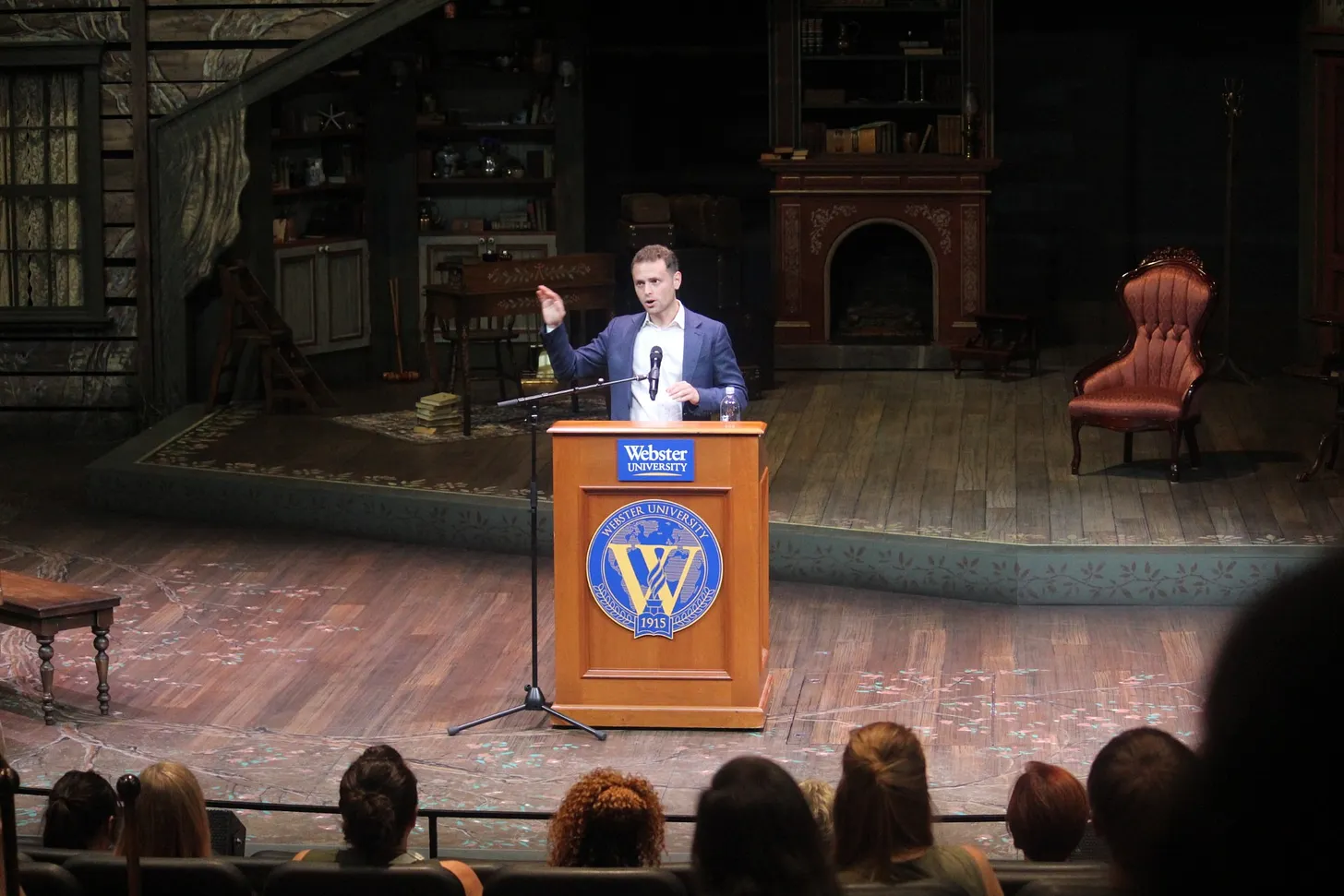
During his appearance last week as Webster’s fall headliner, Aaron Parnas didn’t start with a headline; he started with a confession: He never wanted to be a journalist at all.
The popular TikTok journalist painted a media landscape where the feed – not the newsroom – now decides what counts as news. But it comes with a price.
“There is a real problem with the platform, the algorithms themselves,” Parnas said. “They promote misinformation, they promote outrage, they promote divisiveness.”
Growing up in Florida, Parnas pursued political science and criminal justice in college and earned his law degree at age 21. He recalled that his ambition to go into law was motivated by watching the Casey Anthony trial at age 12.
He was working for a law firm in late February 2022, when Russia launched an attack on Ukraine. Worried about his young cousin in Ukraine who was sleeping in a bathtub to avoid being hit by falling bombs, Parnas began using TikTok to post stories and updates. He got 1 million followers in just one week.
Today, Parnas has more than 5 million followers on TikTok and an additional 5 million more on other platforms. He told an audience of Webster students, faculty and staff, as well as members of the community at large, that the whole structure of U.S. media has undergone a transformation.
“The gatekeeper is gone,” he said. “There are more corridors for you to use your voice. You have your phone, you have a microphone.”
Parnas’ selection as fall headliner was partly influenced by the upcoming midterm elections, according to Jennifer Stewart, director of the Office of Student Engagement.
“Most of his work is around politics and getting young people engaged and just kind of informing people about what’s going on in the world and in the government,” Stewart said. “To be able to have a conversation about what that looks like now, especially because news is very different now in a social media world…was interesting for us.”
Parnas’ talk, “How Social Media Redefines Journalism in the 21st Century,” co-hosted by Campus Activities and WebsterVOTES, was held at the Loretto-Hilton Center on Sept. 15, National Voter Registration Day.
“We can have discussions about politics, but not be partisan,” Stewart said. “We want to make sure that we’re giving everyone the information that they need…so that they can make an informed decision rather than just ignoring it.”
Parnas backed up his unconventional approach to reporting the news with plenty of statistical data, including Pew Research Center information that shows 53% of American adults currently consume news via social media. His accounts alone, he said, have created an estimated 4 billion impressions within the past year, reaching approximately one-third of the country’s population.
Moreover, Parnas stated that 38% of those adults aged 18 to 29 got their news from news influencers like him, while only 8% of those aged 65 and older received their news from social media.
“It’s not a gap, it’s actually a generational canyon – and it’s not closing,” Parnas said.
The division played out in the room, as well. “Veronica,” a 48-year-old graduate student, has been following Parnas for two years. She explained Parnas’ insistence on reporting without sugar-coating anything appealed to her, adding that Parnasʼ famous line “Weʼre gonna break this down,” hooked her from the start.
“Every time you hear that, I’m locked in,” she said.
Justin Kralemann, a content creator who posts under the handle, “The Woke Ginger,” has followed Parnas for several years. He said the appeal for him is Parnas’ independence from any single outlet.
“He’s completely independent,” Kralemann said. “You’re going to be able to have freedom to talk about the things you want to talk about and not have an editorial board or a newsroom saying, ‘We’re not going to talk about this.’”
Parnas kept his message consistent throughout his talk, which extended to a Q&A session with the audience. He especially urged students to register and vote regardless of party, arguing that the disappearance of traditional media gatekeepers cuts both ways: Anyone can now reach an audience, but that access comes with a responsibility to get things right.
“Every single person in this room now has direct, unfiltered access to an audience in a way that has never existed before in human history,” Parnas said. “The only question left is whether you use it…carefully, honestly and in service of the people listening to you – or whether you just add to the noise.”
